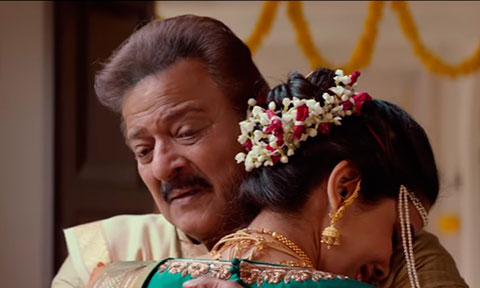
In the midst of an interesting Youtube video, an advertisement suddenly popped up. I looked at the caption, it was a platinum jewellery ad. A young woman was buying holiday tickets to Spain for her parents. 5 seconds passed, and assuming that this would be a breath of fresh air different from the regularised, romanticized sexism, – I did not press the skip button. The father in the ad,however, seemed sad as he commented,- “But beta, who will buy tickets for us next year?” When the daughter replies saying she will, – he again exclaims, “But you will be married. I will do your kanyadaan and then you will be of a different family.” Sitting on the other side of the laptop, I take a deep breath and finally press ‘Skip’.
My socially conditioned yet silently rebellious mind was disappointed at two things. One,- I expected platinum advertisements to be a tad bit more sophisticated than the gold ones ( but almost nothing was different,except here people spoke English instead of a vernacular). And two, I was not vehemently surprised at the course of the conversation,in fact, I was almost prepared that the subject matter won’t deviate much than expected.
And why should I be ? Like most little girls, I have grown up in a society where fine jewellery has been the epitome of femininity that very cleverly conceals all underneath. Here,popular culture and mainstream cinema till the longest period of time has portrayed the meek,docile yet ‘ideal’ daughter-in-law,- who silently weeps as she endures intense humiliation and abuse because her father could not give enough dowry (read mostly gold) to her in laws. The bride’s father in return, pleads and begs with folded hands saying that he will arrange for more as soon as he can. “Oh, its just a film !”, – one might say. But is it ,really? Can we really believe that it is incapable of making any impression on the delicate and soft-like-wet-clay mind of a child? Probably not. I did not like it for sure, but with less consciousness than I have now. But like most others, I have seen people watch such films not with disgust,- but as an ideal weekend mode of wholesome entertainment. And most importantly,- while cinema is mostly an exaggeration,yet, one cannot deny that it is a mirror to our society. A society where ‘marrying a daughter off’ is so big a burden that it stands as a colloquial proverb for every tiresome task. A society that often portrays a woman torn between two sides, and where her status is shown to be dependent upon how rich her father is and how rich her husband will be. A society where a daughter ‘leaving’ after marriage is the most casual norm,so casual that girls grow up listening to it.
I also remember a relative’s wedding, where I was on the ‘groom’s’ side. As members of the ‘bor-jatri‘ ( groom’s family and friends whose arrival initiates the wedding), we were treated with roses at the entrance, and a little girl sprinkled perfume on my dress,while unknown people came up to me asking if I have had food. Deeply overwhelmed by the grand welcome, the 10 year old me felt bewildered. I spotted the bride’s father at a distance, watching him earnestly asking for feedback with clasped hands on whether the arrangements have been fine. In one instant, the cinema character transported itself into reality,- maybe in a more refined,non-cringey manner. Yet,that day,- I remember being upset that Almighty made me a member of this weak and helpless species,- whose fathers seemed to be at the mercy of other’s sympathy . Thankfully,many of us like me are privileged to be brought up in gender-neutral and hugely supportive homes which helps us to shatter almost all kinds of gender-stereotyping. We can educate ourselves and know many things differently than they have been preached. But while many of us grow up to introspect and search for self-esteem, a large number of women and men (current generation included) internalise everything they see. While they know how to separate the ‘good’ from the ‘bad’, and how ‘ female empowerment is crucial’, and how ‘women in their lives are precious’- they still wouldn’t dare or even want to change some ‘basic’ rules. Why meddle with everything?!- will be the most common response.
But what has all of this got to do with good old, sweet and precious jewellery, you may ask. Well. Nothing but again, everything. Since time immemorial, I have shrugged at wedding jewellery advertisements ,for they remind me that somewhere even in show and pompousness and passed-on heritage, my tribe has to accept institutionalized sadness and departure from one’s own family in exchange of glistening diamond and gold. Thankfully, we have the option of ‘skipping’ the ads now. Modern jewellery advertisements are beautiful,emotional,touchy,elegant,sometimes ‘minimal’ for the ‘new age lady’,- but beautiful and emotional nevertheless. Such smooth words that they can camouflage almost everything. Pick up any brand, and you will find actors including celebrities of high stature ‘poignantly’ portraying the pain of a father’s heart as he ‘gives his daughter away’, of the daughter torn between emotions, yet shedding tears of joy and sadness as her father expresses ‘love’ with the most exquisite jewellery. And no matter how much we try to disconnect reel versus real,- most weddings are consumerist affairs,that incur a huge lump sum of expenses,- jewellery being one of the biggest investments amongst them. While both sides of a marriage have progressively begun to share expenses, the age old portrayal of a daughter bidding goodbye to her tearful father doesn’t seem to ever change. The ‘investment’ in gold that we talk about is nothing but a smart method devised to deny a girl child the ‘ Right to Property’, something that women have achieved today with long legal battles and something that women across many communities continue to be denied of. To put it straight, precious jewellery has been the medium of cleanly disconnecting a woman from her family, while at the same time ensuring that without it, a woman is at the mercy of her in laws. It has been regularly shown as a woman’s only source of support when all goes vain,- it is her only pillar of financial strength. For old times sake,hence,it may have been the consolation prize society gave to a woman because she wasn’t allowed to follow her dreams,be educated,and earn for herself. I cannot help but talk about ‘ Goynar Baksho’, – a story of a teenage widow who after being robbed of all good things in a normal life after her husband’s death, is instead forced to be obnoxiously obsessive about her only possessions gifted by her father,- a box full of gold jewellery. Gold or any fine jewellery for that matter, thus, is one of the prime components of ‘Dowry’, – something that we have legally banned in our country but yet it continues to be all-pervasive and informally operate at various levels,cutting across all social classes.
Make no mistake, I am not against embracing femininity,- but however society defines it I choose to define and accept it as per my terms. I would readily hop into the by-lanes of Hatibagan and Esplanade to browse and buy jhumkas , but I do so because it makes me feel happy and not because it is a social norm that validates my parent’s status. Precious metals of high value have huge monetary tags attached to them and while debate may continue about how our country faces huge fiscal deficit to meet the gold demands of the nation via imports,one cannot deny that gold or platinum as a metal,like many other precious metals hold huge intrinsic value,and hence is hugely attractive to the society as a treasured investment.
Which brings me to the final question. In times when more and more women in urban as well as rural areas have become Independent or at least aspire to be so,- why demean her as the same age-old entity in popular culture? When will the brands realise that it is high time that like marriage itself, buying jewellery should be a woman’s choice, and not a necessity that her father has to fulfill as he cries at his daughter’s wedding? When will they realise that a father’s love can never be measured by chunks of expensive jewellery ,and that a parent-child bond is immortal irrespective of regressive rituals? When do we as a society realise, that in a world that aspires to be gender-neutral, marriage should no more signify the departure of a daughter from her family,but rather it should signify exactly what it comfortably does to a man?
Maybe it takes time because it is harmful to the established social structure. Maybe because it endangers the comfortable cushions of our ignorance. But I shall wait. I shall wait for the day when no social norm is specifically applicable to me only because of my gender. I shall wait for the day when ‘a woman’s farewell after marriage’ will be a dead norm that can no more be jokingly thrown about at young girls. A day when a woman and her husband taking care of her family shall no more be an anomaly,but will be normalized as it happens in the reverse manner. I shall wait for the day when all women and men can understand that while buying jewellery is a personal choice, extravagantly perpetuating it as an established norm whose burden is portrayed to be a ‘ father’s heart-wrenching responsibility’,- is not okay. Till then, Happy Women’s Day!
-Abhipsha.










 C'est la vie